
Christiansburg City Directory Holdings
Christiansburg offers one strong local directory snapshot rather than a continuous run. The best starting point is the searchable 1932 volume. It is held through Gathering Blacksburg History and the Blacksburg Museum. Earlier reel references and an 1893-94 business transcription make useful leads. Neither proves year-by-year coverage. For names and addresses after that era, Montgomery newspaper collections supply a different dated record. Note what kind of source each finding came from. A directory entry, a newspaper notice, and a deed answer different questions.
| Collection | Years | Where Held | Access |
|---|---|---|---|
| Christiansburg, Cambria, and Blacksburg directory | 1932 | Blacksburg Museum and Gathering Blacksburg History | Searchable PDF; inspect the page before transcribing. |
| Roanoke-area directory reel lead | 1902-1906, 1903 missing; 1907-1909 lead | Gale/Cengage catalog and a repository still to be confirmed | Catalog lead only, not a verified local run. |
| Montgomery business-directory transcription | 1893-1894 | USGenWeb Virginia genealogy transcription | Free lead; corroborate with an original or scan. |
| Montgomery local-news archive | 1950-2003 | Montgomery-Floyd Regional Library and Advantage Preservation | OCR and page-image coverage vary by title and issue. |
No public catalog documents a continuous Christiansburg reverse or criss-cross run. The publisher named on the 1932 title page also remains unconfirmed. Ask the library, the museum, Virginia Tech, and the Library of Virginia for "city directory," "address directory," "criss-cross," and "reverse directory" holdings. That simple step keeps a promising shelf lead from being mistaken for proof of full coverage.
1932 Christiansburg City Directory
The 1932 searchable directory scan carries a title naming Christiansburg, Cambria, and Blacksburg together. That arrangement matters. A person tied to the railroad or college corridor may appear in the same volume. That entry could sit under a neighboring place heading. Search the surname, the business name, and the street before concluding anyone is absent. The holding page at Gathering Blacksburg History identifies the volume within the Blacksburg Museum collection.
Inside the scan, a reader finds alphabetic resident and business entries. Those pages also hold street addresses, business names, and likely occupation associations. Assigning a publisher is risky, because the imprint was never reliably extracted. A related archival snippet links Wallace Brown Lester with L&N Cleaners. The source page deserves a direct check before quoting any full line. Page review catches initials. It also catches spelling variants and place headings that an OCR search can miss.
Note: The 1932 volume is a valuable local snapshot, while its publisher, field key, and any occupancy marks still call for direct page review.
Reading Christiansburg City Directory Entries
Copy a directory entry as a compact record, never as a bare name. The 1932 scan supports surname and given name, address, occupation or business association, business name or address where present, and a local place heading. The Library of Congress city-directory guide describes the alphabetic resident sections in many directories. It also notes separate address, telephone, or business material in those volumes. Local volumes can be irregular. The Christiansburg page image controls what any entry can claim.
| Name | Copy surname, given name, initials, and spelling exactly as printed. |
|---|---|
| Address | Record the street address and place heading, such as Christiansburg or Cambria. |
| Occupation or business | Preserve the business association, business name, and address when shown. |
| Cross-reference | Note any alphabetic, business, or street-section reference visible on the page. |
| Spouse, owner, or widow notation | Unknown for the inspected 1932 material; do not infer a symbol or abbreviation. |
A Library of Congress directory guide sketches the sections a historic volume may hold.
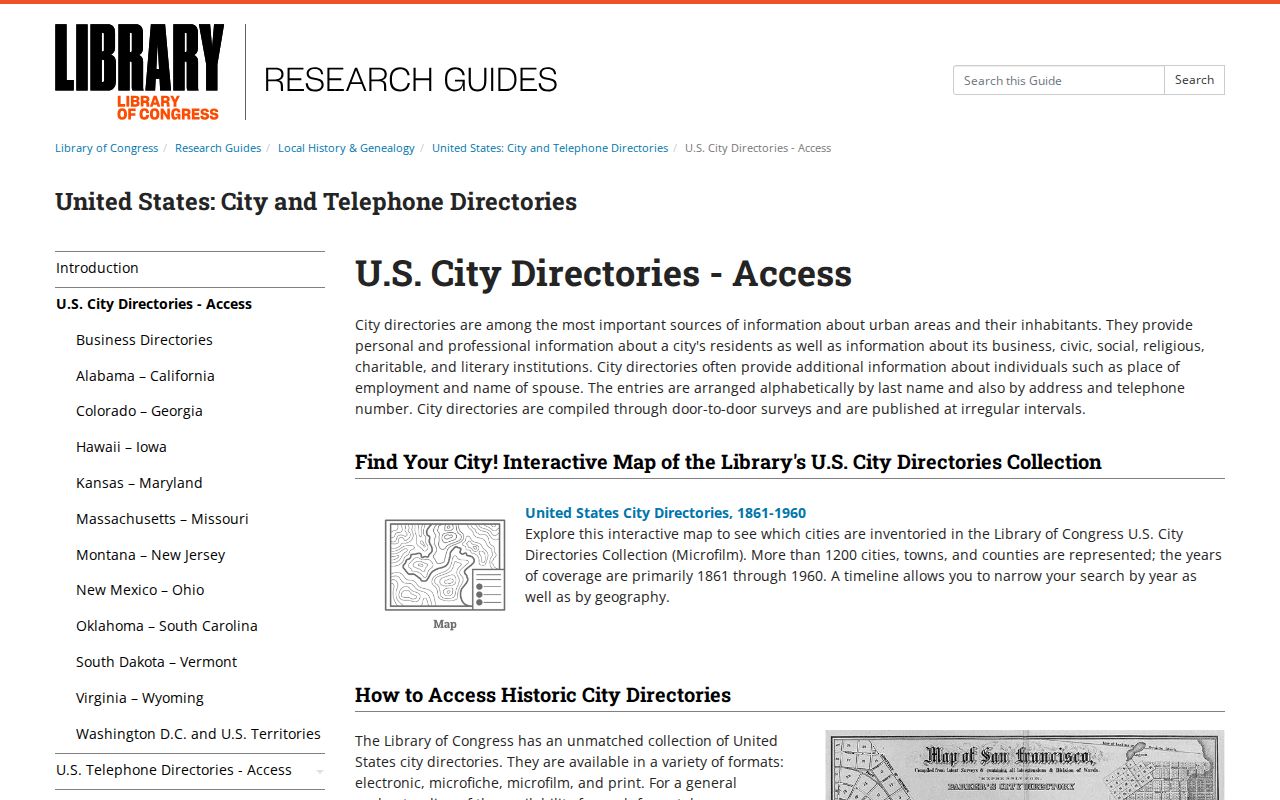
Let that context guide inspection. The Christiansburg page image decides which fields and abbreviations actually appear.
- Criss-cross directory
- A street-order finding section that can lead from an address to a listed name. No verified public continuous Christiansburg criss-cross run was located.
- Householder index
- An index organized around the named household head. Its presence in the available Christiansburg material is not confirmed.
- Abbreviation key
- The volume’s explanation of shortened labels or marks. The exact 1932 key is unknown, so transcribe it only after locating it.
Christiansburg Directory Newspaper Titles
Directories are brief snapshots. Newspapers fill the gaps between them. The Library of Virginia Christiansburg results list Montgomery Messenger from 1869 to 1931. Montgomery News ran from 1924 to 1931. Montgomery News Messenger followed from 1931 to 1967. Later runs include News Messenger. Blacksburg-Christiansburg News Messenger ran from 1974 to 1978, and News ran from 1993 to 1995. Holdings may sit at several institutions rather than one shelf.
Search each title variant with a surname, street, school, business, church, depot, or cemetery term. A notice can yield an address, a family relationship, a move, or a business tie. Compare it against a directory, census, deed, or probate file before settling any identity question.
A Library of Virginia catalog result helps identify title changes before a newspaper search begins.
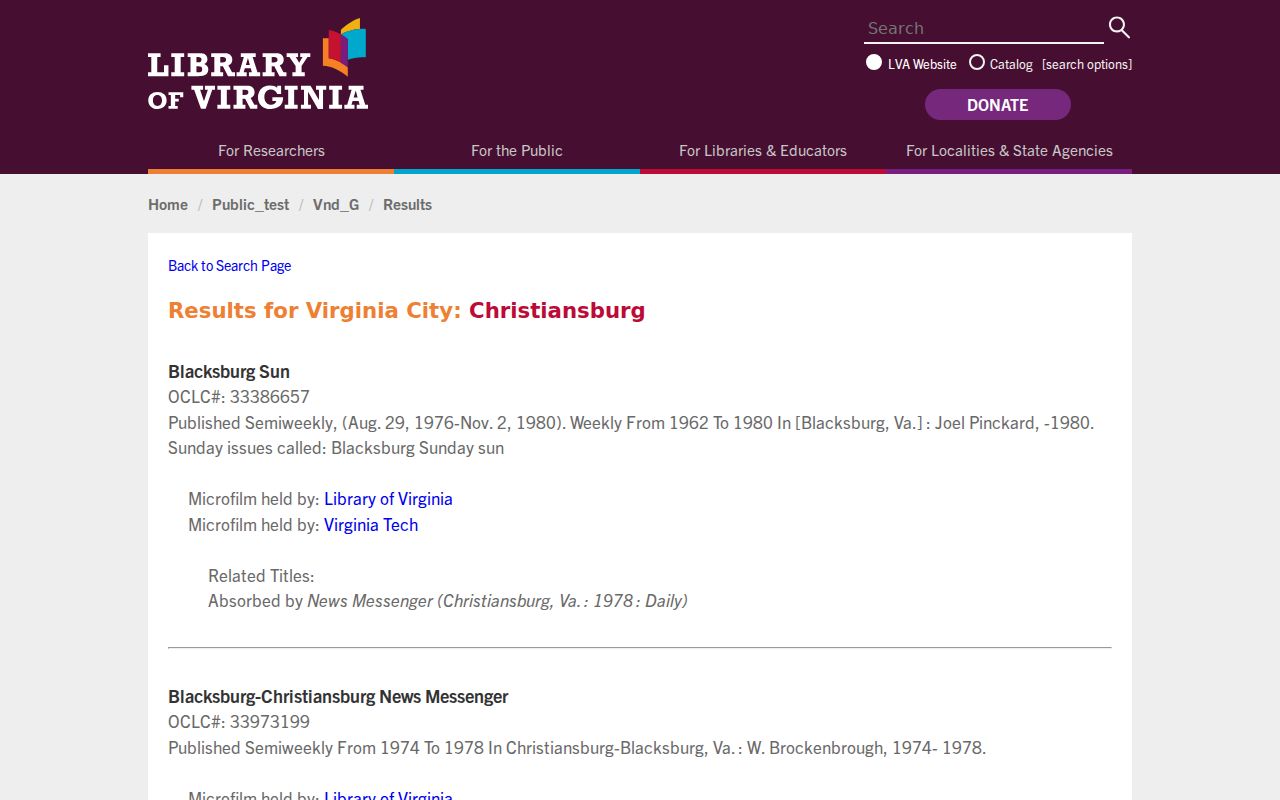
The catalog is a routing aid. It does not promise that every issue is digitized or every page searchable.
Christiansburg City Directory OCR Trail
The Christiansburg digitized newspaper archive pairs well with any directory entry. Its displayed counts include 127,339 Montgomery News Messenger pages for 1950-2001, 60,689 Floyd Press pages for 1901-2019, and 24,566 News Messenger pages for 1974-2003. Those are display counts, not a guarantee that each issue survives. MFRL also describes a digital local-news archive holding Montgomery newspapers from 1950-2003.
Run a name with an address first. Then try a street term or business name. OCR often garbles initials, punctuation, and older type, so open the page image and correct the search term by hand. The MFRL resources at its genealogy page add Virginia Chronicle, Virginia Memory, and library-access research tools. Some online resources require a library card, Find It Virginia authentication, or in-library use.
Note: Archive page counts describe the service display, while a page image remains the evidence for a particular notice or spelling.
Christiansburg Directory Research Rooms
Montgomery-Floyd Regional Library is the public-library route for local newspapers and genealogy resources. The Christiansburg branch is at 125 Sheltman Street, Christiansburg, Virginia 24073, with listed hours of Sunday 1-5, Monday through Thursday 9-8, and Friday and Saturday 10-5. Confirm holiday hours before a visit. Its newspaper list includes News Messenger and regional titles, while its online genealogy page identifies resources that can connect a directory entry to census or newspaper research.
The Montgomery Museum Light Library at 4 E Main Street has colonial-to-present local history, family files, yearbooks, local family histories, census and obituary material, African American resources, and local-history books. Its 1952-1998 newspaper collection is mostly News Messenger and Radford Messenger, with degraded years available by appointment. The museum lists Tuesday through Friday 10:30-4:30 and Saturday 1-4, with Sunday and Monday closed. Call ahead or send a focused request because its small staff cannot undertake unlimited research.
The Light Library research appointment page is the source for planning a bounded directory or surname inquiry.

Name the surname, street, directory year, or school in your request. That gives staff a usable starting point. It also leaves room to compare the result against yearbooks or newspapers.
Cambria Terms in Christiansburg Directories
Place names can shift your result set. Cambria grew around the Virginia and Tennessee Railroad and Cambria Depot after the 1850s. It consolidated with Christiansburg on December 31, 1965. So a person may appear under Cambria in an older directory and under Christiansburg in a later tax or court record without ever moving. Search both community names. Add depot, railroad, station, and Main Street terms too.
Street vocabulary matters as well. Present Franklin Street was formerly Cross Street. A search limited to the current name can miss an earlier directory or deed reference. Keep the original label, then compare it with the parcel's legal description or a deed plat rather than silently converting every historic term to a modern one.
Christiansburg City Directory History
Directories sit inside a longer record story. Montgomery began with Fincastle-era records from 1773-1777, while Montgomery books start in 1777. The county seat is Christiansburg. That is why a family land trail may open under Fincastle rather than Montgomery, even when a later entry says Christiansburg. No courthouse fire erased a named Montgomery record decade. If a lookup comes up empty, test it in the Library of Virginia catalog or ask the Clerk first.
| 1773-1777 | Fincastle-era predecessor records provide the earliest local bridge. |
|---|---|
| 1777 | Montgomery deed and court record series begin. |
| 1866 | Christiansburg Institute was founded, creating a distinct school and family-history trail. |
| 1932 | The verified tri-city directory supplies a dated snapshot. |
| 1965 | Cambria consolidated with Christiansburg, changing a practical place-name term. |
Christiansburg Institute operated from its 1866 founding through desegregation and closure in 1966. School histories, yearbooks, newspapers, MFRL resources, and the Museum's African American materials can add people and institution context a directory cannot supply. Search the school, teacher, student, neighborhood, and date as well as the family name.
Tracing Christiansburg City Directory Households
Work from one dated entry outward. Pair the 1932 directory with the 1930 and 1940 federal census schedules. Then check deeds, tax cards, and newspapers. Add cemetery records and probate material. Federal schedules through 1950 are public under the 72-year rule. Their boundaries, spellings, and household definitions may not match a directory, though. Aim for a supported sequence. Do not claim any single source lists every person at an address.
- Search the 1932 scan under Christiansburg and Cambria, recording the entry exactly as printed.
- Copy the name, initials, address, place heading, business or occupation field, and any visible cross-reference.
- Compare it with the 1930 and 1940 census schedules, then use deeds or tax cards for ownership continuity.
- For an earlier lead, test the 1902-1909 reel reference, the 1893-94 transcription, newspapers, church material, and cemetery records.
- For a later trail, search the 1950-2003 archive, assessor card, deeds, permits, and probate or cemetery sources.
A vanished name can mean a move. It can also mean death, changed spelling, an unlisted person, or a changed community heading. Newspaper notices and probate can narrow the question. Verify with the underlying record custodian before you settle on an answer. For a present-day address chain, the Christiansburg street directory covers the current parcel and street approach.
Note: Historic directories are dated snapshots, so a household trail is strongest when a second record type supports each change.